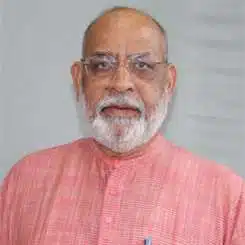
Dr. V P Singh
Distinguished Professor, Jaipuria Institute of Management
“The role of the teacher — the sage on the stage — is ending. Knowledge is everywhere now. We have to move from teacher, to coach, to mentor.”On the evolving role of every school leader
Session recap
Feedback isn't a conversation you have. It's a culture you build — one deposit at a time.
Dr. V P Singh opened the post-lunch "graveyard session" by building directly on the morning's coaching workshop and Arijit's refrain — we are good, the work is to become great. The first reframe was the leader's own role. A **teacher** is the *sage on the stage*, disseminating knowledge to a "parent ego." But knowledge now lives in every phone; that role is fading. A **coach** speaks adult-to-adult. A **mentor** — from the Greek guardian Odysseus left for his son, and our own Vashishtha and Vishwamitra — teaches not skill but attitude and mindset. The principals in the room, he argued, must graduate from teacher to coach to mentor, and he pointed them to ICF (International Coaching Federation) certification as the concrete next step.
He then taught feedback as a discipline with rules, not an instinct. The cardinal rule: feedback is about **performance and behavior, never the person**. He demonstrated with a live praise role-play of Arijit that had four elements — name what was done well, name its impact on the team, signal "I am with you," and ask that the behavior continue — sealed with an appropriate handshake. The source, he was quick to credit, was *The One Minute Manager* (Blanchard & Johnson, 30 million copies sold) — one-minute goal-setting, one-minute praise, one-minute reprimand — and he urged every principal to buy it, read it first, then build a staff book club around it. "Don't light a lamp in another's house before your own."
Two ideas gave the feedback its emotional physics. The **Emotional Bank Account** (Covey): every relationship has a balance, praise is a deposit, reprimand a withdrawal, and you simply cannot withdraw from an account you never funded — including the accounts of the librarian, the canteen cook and the mali, who are praised least and corrected most. And the **8 / 47 / 55 rule**: words carry only 8% of a feedback conversation, tone and pitch 47%, and body language 55%. He demonstrated "May I help you" said three ways — warm, mechanical, hostile — to prove that the same words can deposit or withdraw depending entirely on delivery. Appropriate **touch**, he added, is part of that non-verbal language, and a leader must read the other person's body to know whether the feedback is landing.
“When you praise people, you are making emotional deposits. If you haven't deposited, you cannot withdraw — you cannot be direct, you cannot reprimand. Praise five times before you correct once. Never the reverse.”
The practical spine of the session was a three-stage process. **Planning** — clarity on the message, objective data, the identified impact, and the right time and place (his Sanskrit anchor: *sthan-kaal-patra*, especially for negative feedback). **Delivery** — the **SBI model**, easy to remember as "State Bank of India": Situation, Behavior, Impact ("during yesterday's PTM, you interrupted the mother three times, which visibly frustrated her and stalled progress"). Delivery also demands real **listening** — not hearing, which is mechanical, but the effortful, full-bodied attention that lets you ask exploratory questions and co-create the solution, so ownership of the fix stays with the other person. **Follow-up** — document the agreement, schedule a check-in, recognise the change. Feedback is a journey, not a one-time event.
He widened the lens to two leadership skills the room rarely names. First, **receiving** feedback: a good leader doesn't merely tolerate feedback, they *demand, request and schedule* it — growth requires being coached, not just coaching. Second, **proxemics** — the science of seating. Face-to-face across a table is a negotiation, a confrontation ("Iran and Trump"); side-by-side is collaboration; head-of-table is control. In a feedback session, sit *beside* the person — you are a colleague and partner, not an adversary. He also tackled the maxim "praise in public, reprimand in private," and named the exception: when mistakes or integrity issues repeat, a leader sometimes must reprimand in public to set an example and decide where the line stops.
He closed with the architecture of a feedback *culture* — four pillars, without which nothing sticks. **Value articulation**: candid feedback must be a documented, displayed, communicated value (as it already is at Jaipuria). **Behavior adherence**: the leader must model it and teach staff how to give and take tough feedback. **Symbols / artifacts**: appreciation cards — "I appreciate [name] for [behavior]" — displayed proudly. **System**: a reward structure, financial and psychological, so the behavior repeats because it is recognised. Aditya's closing addition crystallised the human core: touch at the end of a feedback session protects confidence, trust and the relationship — a reminder that the feedback was about the performance, it's now done and dusted, and "we are in it together."
Editorial summary compiled by the LDP team — not a verbatim transcript. Spotted an inaccuracy? Let us know.
Key takeaways
- 1
Graduate from teacher to coach to mentor
The sage on the stage is obsolete — knowledge is everywhere. A coach speaks adult-to-adult; a mentor shapes attitude and mindset. Pursue ICF certification as the concrete next step.
- 2
Feedback is about behavior, never the person
Praise the performance and you may praise the person; but correction always targets the behavior. Separate the two and feedback stops feeling like judgement.
- 3
Fund the Emotional Bank Account first
Praise is a deposit, reprimand a withdrawal. You cannot withdraw from an empty account. Five genuine praises earn one correction — and the librarian, cook and mali have accounts too.
- 4
Deliver with SBI, listen for real
Situation, Behavior, Impact ("State Bank of India"). Then listen — effortfully, not mechanically — and co-create the fix so ownership stays with the other person.
- 5
Feedback is a journey: plan, deliver, follow up
Plan with data and the right time and place (sthan-kaal-patra). Deliver with SBI. Then document the agreement, schedule a check-in, and recognise the change. Never a one-off.
- 6
A culture needs four pillars
Value (documented and displayed), Behavior (modelled and taught), Symbols (appreciation cards on the wall), System (rewards, financial and psychological). Miss one and the culture won't hold.
What he spoke on
Teacher → Coach → Mentor
Teacher disseminates knowledge (sage on the stage, speaks to the "parent ego"); coach speaks adult-to-adult; mentor teaches attitude and mindset (Vashishtha, not Dronacharya). The leader's role is evolving up that ladder.
The Emotional Bank Account
Every relationship holds a balance. Praise deposits; reprimand withdraws. No deposits, no withdrawals. Maintain a 5:1 praise-to-correction ratio — and don't forget the non-teaching staff.
The 8 / 47 / 55 rule
Words carry 8% of a feedback conversation, tone and pitch 47%, body language 55%. The same sentence can build or wound depending on delivery. Read the other person's body to know if it's landing.
The SBI model + Plan / Deliver / Follow-up
Plan (data, impact, sthan-kaal-patra). Deliver via Situation-Behavior-Impact, with real listening and co-created solutions. Follow up — document, schedule, recognise. "State Bank of India" makes SBI unforgettable.
Proxemics — where you sit is what you say
Face-to-face is confrontation; side-by-side is collaboration; head-of-table is control. In a feedback conversation, sit beside the person — partner, not adversary.
The four pillars of a feedback culture
Value articulation (document it), behavior adherence (model and teach it), symbols (appreciation cards, displayed), system (reward it, financially and psychologically). Culture-building is a long journey worth taking.
Q&A captured
Q. How do you actually praise someone? (the live role-play)
Dr. Singh praised Arijit in four moves: named what he did well (the "good to great" kick-off for the three-day JLP), named its impact on the team, said "I am with you, continue this," and closed with a handshake. Praise the performance specifically — generic praise doesn't deposit anything.
Q. Isn't "praise in public, reprimand in private" an absolute rule?
No. It's the default, but when mistakes or integrity issues repeat despite private correction, a leader sometimes must reprimand in public — to set an example and signal where the line stops. The CEO has to decide that.
Q. What's the difference between empathy and sympathy?
Sympathy is samvedna (feeling for someone); empathy is anubhuti (feeling with them, from inside their experience). Feedback that lands comes from empathy, not sympathy.
Q. Why does touch matter in a feedback session? (Aditya's addition)
Feedback isn't only about correcting performance — it's about preserving confidence, trust and the relationship. An appropriate touch at the end does two things: it lifts those three a notch, and it signals the feedback was about the performance, it's now done and dusted, and "we are in it together."
Q. How do I build the culture, not just the skill?
Four pillars: articulate candid feedback as a documented value; model and teach the behavior; create symbols like appreciation cards and display them; and back it with a reward system, financial and psychological. Skill without these four stays an individual habit, never a culture.
Influencing Parents — Beyond the PTM
How do we make the parent a real partner, not the 12th man?
"The primary job of a leader is to influence — your educators, your children, and your parents. Yet our education system has gone almost blind to the parent."
"A child is with parents for 16 hours and with us for only 8 — yet we treat the parent like the 12th man, called in only to field, never to bat."
"Is the PTM the only medium through which we can influence parents? The real question is what lies beyond it."
Session recap
Parents are the third side of the triangle we keep ignoring — and the PTM is only the beginning of fixing that.
Dr. V P Singh opened Leadership Discourse 6 with a structural observation about Indian education: parents are systematically undervalued. He drew the school as a triangle — educators on one side, the child on another, parents on the third — and argued that we have built a system almost blind to that third side. The arithmetic was his sharpest tool: a child is awake roughly 16 hours, and the school holds only about 8 of them. The other half belongs to the home. A school that pours effort into its 8 hours while the parent's 16 pull in a different direction is, he said, "mixing water in a leaking bucket."
He reframed the leader's core job as influence — of educators, of children, of non-academic staff, and crucially of parents. Two metaphors anchored the room. The parent as the 12th man: called onto the field only to field, never to bat or bowl, present but never fully in the game. And the parent as the second wheel of a chariot (offered by a principal from the floor): the school is one wheel, the parent the other, the child is who the chariot carries — and if one wheel breaks, the chariot stops. Dr. Singh accepted the metaphor and pushed it further: if the parent is a true partner, the dominant partner (the school) must give more respect and more support, not less.
The session then turned to the PTM itself. Has it quietly become a complaint desk — the school complaining about the child, the parent complaining about the school, and no one owning the outcome? Dr. Singh argued that the quality of a PTM rests on a stack most schools under-build: planning, the strength of data collection, the slotting of parents, the conduct of the meeting itself, and — the most neglected — follow-up. He borrowed a discipline from sales and marketing: objection handling. When a parent objects that the transport is poor or the teaching is weak, that is an objection to be handled with a listening mindset and data, not absorbed as a grievance. He prescribed a 48-hour acknowledgement of what was discussed and agreed, and a 30- or 60-day check-in to see what actually moved.
"We are not saying you aren't doing the work — you are. We are saying there is far more scope to make the parent a larger, fuller department of the school. That is the move from good to great."
The energy of the room shifted when the floor began sharing Student-Led Conferences. One principal described a pilot with Class 10 and 12: students built a five-minute presentation charting their own journey — where they began, last year's result, current marks, work habits, time on academics and co-curriculars, and a plan for the future. The teacher didn't talk; the child did. The response was overwhelming — parents filming it, embracing it, with no complaints to raise because the child had taken ownership. A Patna principal had run student-led PTMs across every grade after a multi-year build. And Aditya brought the clincher: his own daughter has done SLCs since Grade 1, starting with a simple A4 reflection ("what did you enjoy most, where did you excel, where did you fall short, what will you do to improve") and progressing to 7–8 minute subject-wise presentations by Grade 5. SLC, the room realised, is not a senior-grade luxury — it scales from age six.
Dr. Singh closed by widening the aperture beyond the PTM entirely. Back to basics, then beyond. A Parents' Masterclass on digital well-being and how to support learning at home without confrontation. A 120-second video from the principal sharing the school's story, uniqueness and expectations of parents. A weekly or fortnightly broadcast spotlighting a student, a teacher, or one actionable parenting tip. Good-News Notes — handwritten, personalised — to counter a media diet of nothing but war and negativity ("can I create goodness around my stakeholders?"). And a reframe of the parent body itself: not an audience but a resource pool of MBAs, doctors and lawyers a school could draw on. The throughline, echoing Arijit's refrain, was the 2030 standard: we are good; the work of this discourse is how we become great — by making the parent a real partner, not the 12th man.
Key takeaways for principals
1.The parent is the third side of the triangle
Educators, child, parent. We have built a system almost blind to the third. A child is home 16 hours and at school 8 — ignoring the home means mixing water in a leaking bucket.
2.Stop treating parents as the 12th man
Present but never in the game. If the parent is the second wheel of the chariot, the dominant partner must give more respect and support — a broken wheel stops the whole journey.
3.A PTM is not a complaint desk
Build the quality stack: planning, data, slotting, conduct, follow-up. Bring a listening mindset and data, not defensiveness. Learn objection handling the way sales teams do.
4.Close the loop after every PTM
48-hour acknowledgement of what was discussed and agreed; a 30- or 60-day check-in on what actually changed. Without follow-up, the conversation evaporates.
5.Student-Led Conferences flip the script
When the child presents their own journey and plan, ownership shifts, complaints fall away, and parents are moved. It works from Grade 1 to Grade 12 — start simple, build up.
6.Go beyond the PTM
Parents' Masterclass, a 120-second leader video, weekly broadcasts, Good-News Notes, and treating parents as a resource pool. The PTM is the floor, not the ceiling.
What he spoke on
The education triangle
Educators, parents, child. Higher education abandoned the parent entirely; school education risks the same. The leader's job is to keep all three sides engaged — especially the one we forget.
The PTM quality stack
Plan it. Collect strong data. Slot parents thoughtfully. Conduct with a listening mindset. Follow up rigorously. Most schools build the first three and neglect the last two.
Objection handling for schools
A parent objection (transport, teaching quality) is not an attack; it's a sales-and-marketing skill. Handle it with data and listening — train teachers and students in it.
Student-Led Conferences (SLC)
The child charts their own journey, results, habits and plan. Ownership moves to the student; parents are moved; complaints dissolve. Scales from a Grade-1 A4 reflection to a Grade-5 subject-wise presentation.
The Beyond-PTM toolkit
Parents' Masterclass on digital well-being; a 120-second principal video; weekly/fortnightly broadcasts; Good-News Notes. Small, repeatable touches that make the parent a fuller department.
Parents as a resource pool
The parent body holds MBAs, doctors, lawyers — a resource, not just an audience. Give them a real (~20%) role and tell the school's stories better, including across the network's own channels.
Q&A captured
Q. How should we frame the parent's role? (the chariot metaphor)
A principal offered it and Dr. Singh built on it: the school is one wheel, the parent the other, the child is who the chariot carries. If one wheel breaks, the child cannot move forward. The implication — the dominant wheel (school) owes the other more support, not less.
Q. What's a simple first step to involve parents more deeply?
One principal now personally calls the parents of each class into the office, with full respect, to ask what they want and what feedback they have — beyond the standard pre-camp schedule. Small, direct, and it changes the relationship.
Q. How do we share what's working across campuses?
The HOS WhatsApp group is one-way appreciation traffic. The room agreed to create a separate "best practices" group to share real, un-flashy stories of what each campus has tried and achieved — so others can adapt them in context.
Q. How do we get both parents to attend, not just one?
One campus introduced a games day where both parents must be present for the child to participate — and awards the winners. The child now asks both parents to come.
Q. Does Student-Led Conferencing only work for senior grades?
No. Class 10/12 pilots drew overwhelming responses, a Patna campus runs it across every grade, and Aditya's daughter has done SLCs since Grade 1 — starting with a four-question A4 reflection and progressing to full subject-wise presentations by Grade 5.
Q. If we already do these things, what's the ask?
Consolidate the good practices, document them, and make them available (recommended, not mandated) across the network. Then build quality and go beyond — the move from good to great for 2030.
Themes from the session
Resources from this session
- Influencing Parents — Dr. V P Singh (deck PDF)
- PTM quality framework (plan · data · slot · conduct · follow-up)
- Beyond-PTM ideas — reference
When everything is important, how do you choose?
The Day-3 capstone — prioritisation as the leader's hardest discipline.
"When everything is important, how do you choose? That is the question every leader has to answer."
"Your success lies in knowing where to say no. The problem is — we don't know where to say no."
"The body has only four or five vital signs that decide life and death. Everything else is important — but supplementary. What are the vital signs of your role?"
Session recap
When everything is screaming for your attention, leadership is knowing the few things that actually decide life and death.
Dr. V P Singh opened the final discourse by tying the whole JLP journey together. Coaching, feedback, influencing parents — none of these were destinations, he reminded the room; they are ongoing journeys barely tested at the surface. He recapped the throughlines: in coaching mode you speak adult-to-adult, not parent-to-child; feedback must be on the spot, specific, tied to organisational impact, and end by encouraging the behaviour to repeat; and parents remain the under-opened "third eye" of the school ecosystem. Then the line that set up the day: the buck stops with the leader. "We are the fountainhead. We create culture, not third parties. Invest in yourself."
The day's theme was the dilemma every principal lives: everything is important, every stakeholder matters, the demands never stop — so how do you choose? Dr. Singh was blunt that the whirlwind is permanent. Students won't stop demanding, parents won't stop, owners won't lower their expectations of results, reputation and economics. The storm will continue. The skill is not escaping it; it is learning to focus inside it.
His first lens was Vital Signs. The human body has only four or five — blood pressure, heart rate, respiratory rate, body temperature, and now oxygen level — and they are the parameters that decide life and death. When a trauma patient arrives, the doctor checks vitals first, before anything else. Everything else — consciousness, pain, blood sugar — is supplementary: important, but not vital. The question he pressed onto every leader: what are the four or five vital signs of your role and your school — the ones that define your success or failure — and are you checking those first?
"Deciding what *not* to do is as important as deciding what to do — actually, more important. Your success lies in knowing where to say no. The problem is, most of us don't know where to say no."
The second lens was Pareto's 80-20 principle. Two hundred years ago the Italian economist found 80% of Italy's wealth concentrated in 20% of hands, and the pattern held across countries and centuries. It holds in a school too: roughly 20% of your activities produce 80% of your results, and 80% of your activities produce only 20%. The discipline is to identify and protect the vital 20% — and to stop over-investing in the trivial 80% simply because it is urgent or visible.
Those two lenses converge on Wildly Important Goals — the few objectives that actually move the school, chosen deliberately when everything is competing for attention. Dr. Singh closed with the air-traffic-control image: a controller at Delhi airport is tracking thirty or forty planes at once, aware of all of them — but at any given moment the focus is on the one plane landing. That is leadership in the whirlwind: hold awareness of everything, but focus on the one vital thing in front of you. The 8-minute "whirlwind" film he replayed makes the same case — execution survives the whirlwind only when you protect focus on the wildly important few.
Key takeaways for principals
1.The whirlwind is permanent
Students, parents and owners will never stop demanding. Don't wait for the storm to pass — it won't. Leadership is learning to focus inside it, not escape it.
2.Know your vital signs
The body has only 4–5 signs that decide life and death; a doctor checks them first. Identify the 4–5 that decide success or failure for your role — and check those before anything else.
3.Supplementary is not vital
Consciousness, pain, blood sugar matter — but they aren't vital signs. Much of what fills a principal's day is important but supplementary. Don't let it crowd out the vital.
4.Pareto: protect the vital 20%
20% of your activities produce 80% of your results. Find that 20%, protect it ruthlessly, and stop over-investing in the trivial many just because it's loud or urgent.
5.Choose your Wildly Important Goals
When everything competes, deliberately pick the few goals that actually move the school. Awareness of everything; focus on the vital few.
6.Success is knowing where to say no
Deciding what *not* to do matters more than deciding what to do. The discipline most leaders lack is the clean, deliberate no.
What he spoke on
Vital Signs
Four or five parameters decide life and death; everything else is supplementary. Ask of your role: what are my vital signs, and am I checking them first — the way a doctor does in trauma?
Supplementary vs Vital
Important is not the same as vital. Oxygen, pain, consciousness are real and they matter — but they are not the life-and-death few. Sort your work the same way.
Pareto's 80-20
From Italy's wealth two centuries ago to a school today: 20% of inputs drive 80% of outputs. Identify the vital 20% and stop letting the trivial 80% set your calendar.
Wildly Important Goals
The deliberate few that move the institution. When everything is important, WIGs are how you choose. Awareness of all, focus on the vital.
The whirlwind
The permanent storm of stakeholder demand. It won't subside, so execution can't wait for calm. Protect focus on the wildly important *inside* the whirlwind.
Air-traffic-control focus
Track forty planes, focus on the one landing. Hold full situational awareness, but give your attention to the single vital thing in front of you, then the next.
Q&A captured
Q. What are "vital signs"?
The room defined them medically — temperature, respiratory rate, heart rate, blood pressure, and post-pandemic, oxygen. Dr. Singh's move: these four or five decide life and death, which is why a doctor checks them first. Translate the concept to your role — what defines your success or failure?
Q. Aren't there more than four or five things that matter?
Yes — consciousness, pain, blood sugar and more are real and important. But they are supplementary vital signs, not the core ones. The leadership lesson is the same: distinguish the genuinely vital from the merely important.
Q. What is the Pareto / 80-20 principle?
The room offered it: 20% of effort (or 20% of the team) produces 80% of the result. Dr. Singh traced it to Vilfredo Pareto's study of Italy's wealth distribution and extended it — focus on the 20% of activities that yield 80% of outcomes.
Q. So how do I actually choose when everything is important?
Run your work through the three lenses: which of these are my vital signs, which fall in my vital 20%, and which are my wildly important goals? What survives all three gets your focus. The rest gets a deliberate "no."
Q. Will the demands ever ease?
No — and planning as if they will is the mistake. The whirlwind is structural. The skill is air-traffic-control focus: aware of everything, attending to the one vital thing at a time.
Themes from the session
Resources from this session
- The whirlwind film (8 minutes) — Dr. V P Singh
- Vital Signs / Pareto / WIG — worksheet
- Companion document shared with the film
- Full transcript